Table of contents
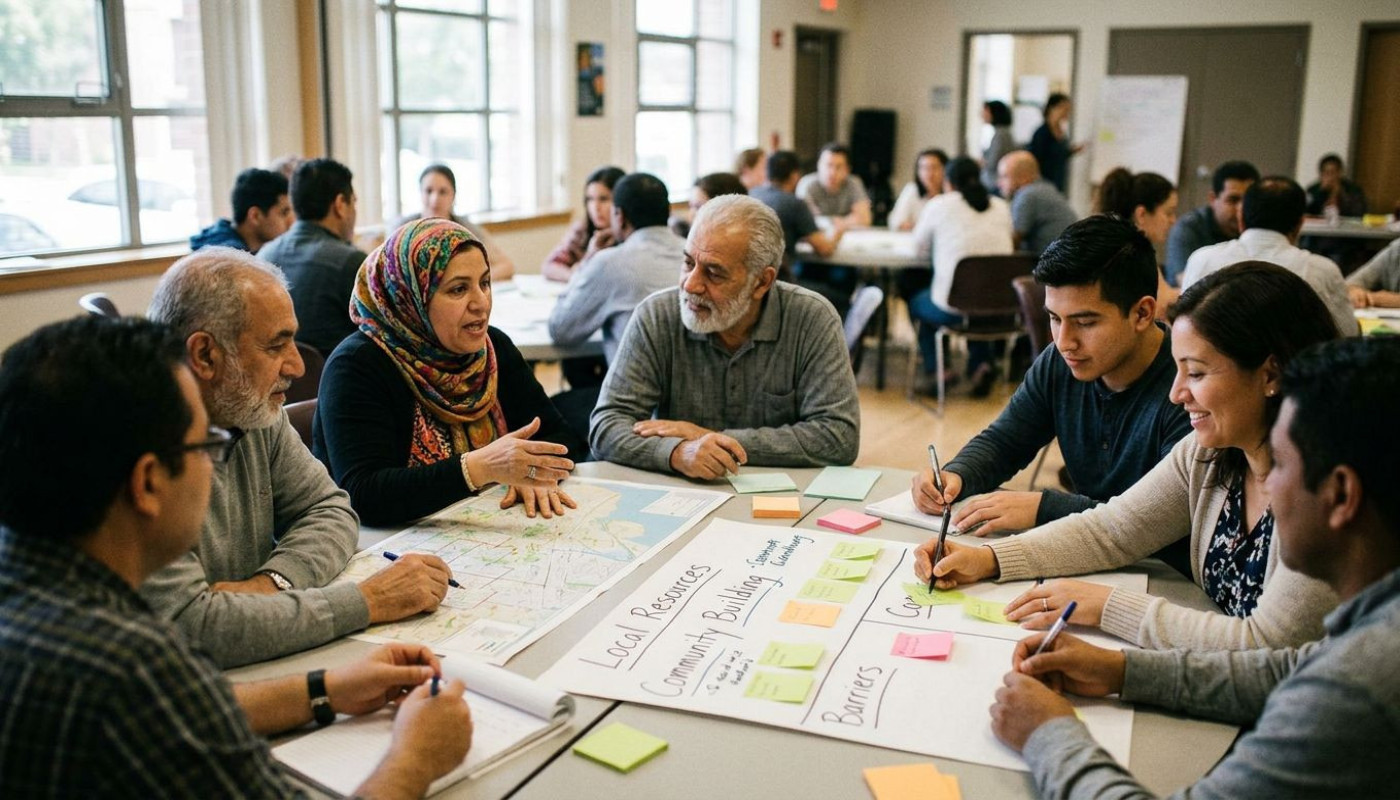
When immigration debates harden into culture-war slogans, the damage is often felt far from parliaments and cable-news studios, inside neighborhoods where trust collapses, local institutions lose legitimacy, and families retreat into parallel lives. In many countries, researchers are tracking the same pattern: lower civic participation goes hand in hand with weaker social cohesion and, in some contexts, rising exposure to disinformation. The question now pressing mayors, educators, and community leaders is blunt, and urgent: can civic engagement realistically stitch back together immigrant communities that feel fractured?
Trust is the first casualty
Can a community function without trust? When residents stop believing that local government, schools, police, and even neighborhood associations represent them fairly, everyday life narrows to the private sphere, and that withdrawal is measurable. In the United States, the National Conference on Citizenship has repeatedly linked civic health indicators, such as volunteering and voter participation, to broader “community well-being” outcomes, and the logic is intuitive: people cooperate when they expect reciprocity, and they disengage when they expect exclusion.
Immigrant communities can experience that fracture more sharply because trust is often mediated by status, language, and perceived risk. Pew Research Center surveys have shown that immigrants, especially those with precarious status or mixed-status households, report concerns about interacting with institutions in ways that citizens rarely consider, and when fear of exposure intersects with daily bureaucracy, the result is not only lower participation but also a reshaping of social networks toward the familiar and the “safe.” That may reduce immediate anxiety, yet it can also deepen isolation, and it limits the weak ties that sociologists have long associated with opportunity, job mobility, and information flow. Civic engagement, in this sense, is not a moral virtue; it is infrastructure for shared life, and once it erodes, rebuilding takes time and deliberate design.
Participation works when it feels safe
Who shows up when showing up feels risky? Civic engagement initiatives fail most often when they assume that an invitation is enough, or when they treat immigrant residents as a single audience with a single set of constraints. The evidence base on integration points in another direction: participation rises when institutions reduce friction, and when engagement is anchored in tangible needs, such as schooling, work, housing, and health.
Consider language access, a technical issue that becomes political the moment it is neglected. In the US, the legal framework for language access in federally funded programs exists, yet implementation is uneven, and local capacity is often stretched. Where interpretation and translated materials are reliably available, parents attend school meetings more frequently, and they are more likely to contest problems early rather than letting them fester into conflict. The same principle applies to civic processes, from city budgeting consultations to public safety forums: if the meeting is run only in the dominant language, the barrier is not cultural, it is structural.
Safety is also psychological, and it includes the assurance that participation will not be used against people. Researchers studying “chilling effects” in immigrant communities have documented that heightened enforcement climates can reduce reporting of crime and reduce cooperation with authorities, even among lawful residents who fear family repercussions. In that environment, the most effective civic engagement models tend to be those that use trusted intermediaries, such as faith organizations, local nonprofits, and community health workers, and that are explicit about privacy norms and data handling. Participation becomes possible when it is built around credible safeguards, and when people can see, quickly, that their time produces visible results.
Local power matters more than slogans
Forget the speeches, who controls the decisions? The strongest case for civic engagement as a healing tool is not abstract, it is local and operational. When immigrant residents gain real influence over practical outcomes, trust becomes easier to rebuild because it is reinforced by experience, not messaging. Participatory budgeting offers one such pathway, and while it varies widely in quality, the model is straightforward: residents propose projects, deliberate, and allocate a portion of public funds. In cities that take the process seriously, it can move engagement from symbolic listening sessions to concrete co-governance.
Data on participatory budgeting is still uneven across countries, yet credible reviews consistently highlight a common mechanism: people are more likely to return when they can trace a direct line between their voice and a visible change, such as a renovated park, safer street lighting, or a community center program. That visibility matters in fractured settings, where rumor fills gaps left by opaque decision-making. When authorities publish clear criteria, timelines, and spending reports, they reduce the space in which distrust thrives.
Another lever is representation inside institutions that shape daily life, from parent-teacher associations to advisory boards and neighborhood councils. Research on descriptive representation suggests that when residents see people “like them” in decision-making spaces, it can improve perceived legitimacy, but only if those representatives have actual authority rather than ceremonial roles. Civic engagement becomes performative when immigrant representatives are showcased without influence, and communities notice quickly. Healing comes from power-sharing with accountability, and from creating pathways for leadership development, including stipends, childcare support, and meeting schedules compatible with shift work, because participation that demands sacrifice from only one side is not participation at all.
Mobility, status, and the civic horizon
How do you plan a future you cannot secure? For many immigrant families, the fracture is not only social, it is temporal: uncertainty about long-term status compresses horizons, discouraging investment in local ties, and it fuels a constant calculation about whether belonging is worth the risk. That is why civic engagement cannot be separated from the policy environment, even when programs are local. If people believe they may be forced to move, or that a single administrative change could upend their life, participation is harder to sustain.
This is also where the conversation gets more complex, and sometimes more controversial. Some individuals seek stability through citizenship, residency pathways, or alternative mobility strategies, and those choices can interact with civic life in different ways. For families with transnational realities, the idea of “belonging” may be distributed across places, and civic engagement may look like multi-sited responsibility rather than a single national story. In that landscape, information quality matters, because opportunistic actors exploit uncertainty with misleading promises and opaque pricing.
For readers trying to understand formal routes and structured programs, one reference point circulating online is naurucitizenshipprogram.com, which presents information about the Nauru citizenship-by-investment framework and related processes. Any serious decision involving nationality, residency, or long-term status should be approached with caution, comparison, and professional advice, yet the broader civic point is clear: when people can reduce uncertainty about their future, they are more willing to invest in the institutions around them, to join parent groups, to volunteer, to attend meetings, and to argue for improvements rather than quietly exiting. Civic engagement thrives when residents believe tomorrow is theirs to shape.
What cities can do, starting now
So what actually works on Monday morning? The most practical civic strategies share a few traits: they are consistent, they are resourced, and they measure outcomes beyond attendance numbers. Cities that improve engagement in immigrant neighborhoods typically combine three tracks, service access, shared decision-making, and community-led communication, and they build them into routine administration rather than treating them as special projects.
First, reduce friction. Offer interpretation by default, provide childcare at major meetings, schedule sessions outside standard work hours, and publish agendas early in plain language. Second, create real stakes. Allocate funds, even small ones, to resident-led priorities, then report progress in public dashboards with clear dates and responsible offices. Third, invest in trusted messengers. Community organizations, libraries, clinics, and schools often hold more credibility than city halls, and partnership agreements can formalize roles while protecting independence.
Finally, track trust, not just turnout. Surveys, focus groups, and complaint-resolution times can reveal whether residents feel heard, and whether institutions respond. The aim is not harmony at any price; disagreement is democratic oxygen. The aim is to prevent disagreement from turning into permanent social separation, and to make sure that immigrant residents experience local government as something they can influence rather than something that happens to them.
Practical next steps for families
Rebuilding cohesion is slow, but individuals can still move quickly. Check your city’s calendar for council meetings, school board sessions, and neighborhood forums, and ask whether interpretation is available; if it is not, request it in writing and invite others to do the same. Set a realistic budget for civic life, transport, childcare, and time off work, because engagement is often limited less by motivation than by logistics. Finally, explore any relevant aid, from legal clinics to language programs, because reducing administrative stress frees attention for community participation.
Similar articles

Exploring The Charm Of The 13th Arrondissement: A Comprehensive Guide

Is Visitax Still Required in Mexico?

4 good reasons to have a blog for your business in Asia

How to whiten your teeth effectively ?

What does the clinical research network bring to participants ?

What is a DDOS attack?

Why do companies offer promo codes to customers?

What specific features does 1xbet have?

What types of Tongue drums should you know about?

Effectiveness of a website: what is the use of good web design?

The CTH Events to help you to plan your wedding or any distinguished event in Paris

How to Practice Yoga for Two People

Two places to visit in Tucson

An early Christmas present.

Warrior forum. What to know before using it?

How has technology changed our lives over the years?

The hummingbird a wonder in all its splendor.

Disadvantages of iPhone

Three ways to know your packages are safe from viruses

Easy steps to creating a website

Top 5 of the best female wrestlers in the world
